
Generative AI development is evolving rapidly beyond basic API calls toward continuous local execution and hardened frontend integrations. Educative’s latest update highlights two key shifts every developer and engineering team should pay attention to: building always-on, privacy-focused local agents using open-weight 30B models and mastering frontend patterns for handling non-deterministic AI payloads.
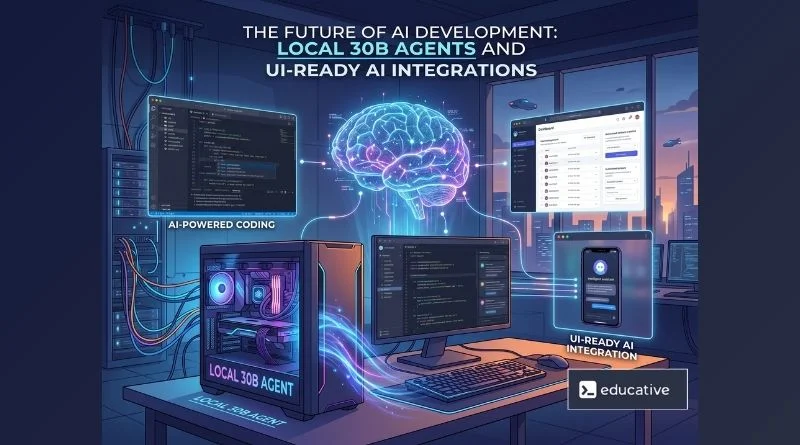
1. Running Always-On Local AI Agents on a Single 24 GB GPU
Cloud AI APIs can quickly become cost-prohibitive and present privacy risks for continuous background tasks such as repository indexing or real-time code scanning where thousands of metered calls are required and proprietary source code is sent off-site.
Recent August open-weight model releases including Qwen3.8-27B, Muse Glimmer 30B, and Nemotron 3.5 Lightning change this paradigm by making full agentic workflows runnable locally on a single 24 GB GPU.
Key Technical Takeaways:
- Memory & Architecture Efficiency: Qwen’s 3:1 Gated DeltaNet hybrid architecture allows a 128K context window to fit within VRAM levels comparable to a dense 7B model.
- Quantization Trade-offs: Tool-call accuracy varies significantly depending on quantization levels: 4-bit Medium: Retains 97% tool-call accuracy. 1 3-bit: Accuracy drops sharply to 84%.
- Practical Implementation: Building a local workspace monitoring daemon involves orchestrating local Qwen instances via Ollama, applying schema-validated patches within a sandbox environment, and adhering to OWASP GenAI 2026 security rules.
👉 Read the full breakdown in the Educative Newsletter on Local AI Agents
2. Engineering the Frontend for AI Model Outputs
Most Generative AI courses stop at backend API calls, leaving engineers unprepared for how frontend interfaces should process and render non-deterministic AI outputs. Educative’s new course focuses on what happens after the API response is received.
Key Skills & Workflows Covered:
- Structured Outputs & Prompting: Crafting prompts designed specifically to produce structured, UI-ready data payloads.
- Interactive Testing: Evaluating prompt behavior against real-world test scenarios in interactive prompt widgets prior to writing UI code.
- React Feature Building: Constructing UI components, such as sentiment checks, constrained summaries, and reference comparison tools equipped with robust handling for latency, waiting states, failure modes, and prompt-injection security risks.
👉 Start mastering these patterns in the AI for Frontend Engineers Course
Strategic Takeaway for Developers
Whether you are scaling continuous background agents without cloud API expenses or building resilient frontend interfaces that handle unpredictable AI outputs gracefully, staying ahead in GenAI requires practical, hands-on architectural skills.
Check out Educative’s interactive platform to level up your AI engineering capabilities today!